Featured

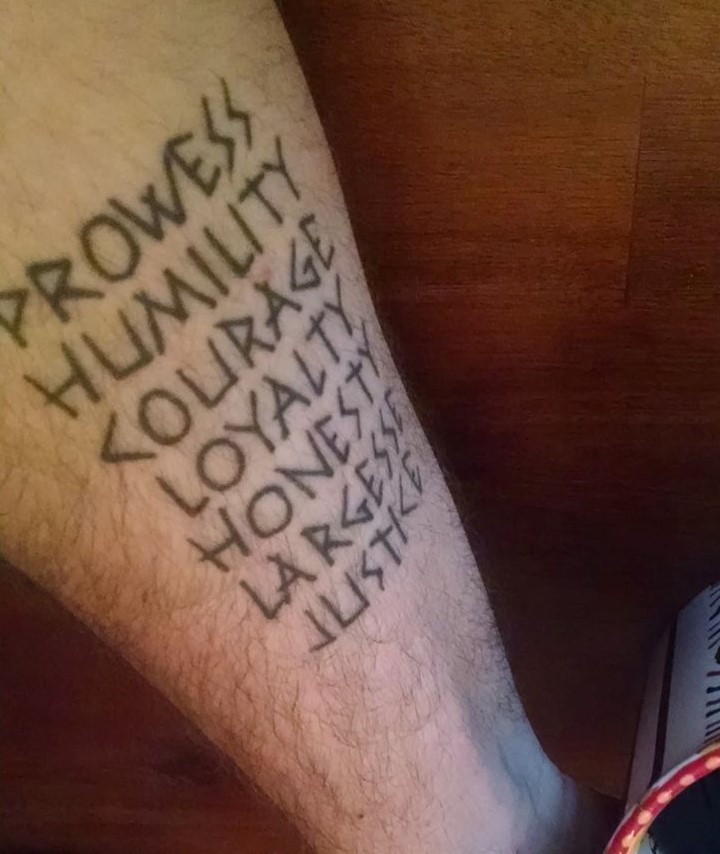
The Virtues

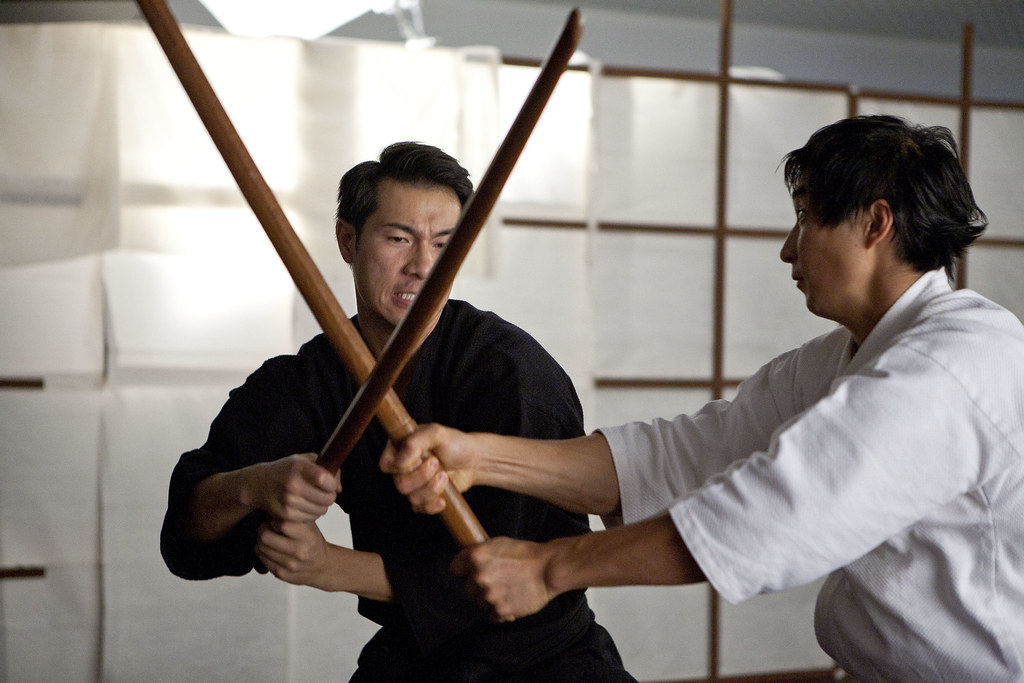
Image courtesy of Robert Gratton

No, mom, that isn’t my arm.

But those are the values I’m discussing; the virtues I’m seeking to develop. This is what I’m looking for in these volumes.

But words are tricky. We’re all pretty sure what they mean to us. But what they mean to someone else can be a mystery. And when you saddle words with value judgments, it becomes even more difficult. A word that references a heroic trait to one person might label a vicious monster to another. So here I’ll start trying to constrain these particular words.

I’m not going to define them, exactly. In the effort to be studious and not pretend to mastery, I’m going to label them and try to capture their conceptual flavor. One day, I hope to embody them, so that they need no definition, only an example. But that day, if it ever comes, is a long way from now.
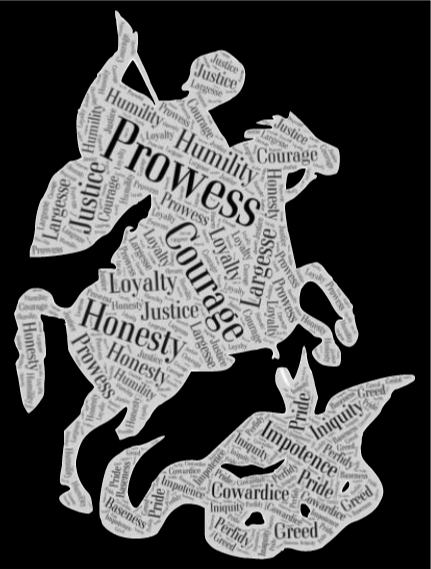
Prowess – Prowess is the hardest to define in modern terms because it is intrinsically linked to violence and the capacity for violence. For good reasons, we tend to look askance at the idea of great capacity to be effective with violence as a “virtue.” But for Chivalry, it is essential to embody and project the fact that one is “a killer on each and every field they stand on.” (These words from from my knight, Count Alric KSCA, in his long definition of Prowess.)

But Prowess is not simply the ability to deal out violence. It encompasses the ability to truly transform the battle, whether in tournament or warfare, into a showcase of the martial arts. Winning in a mad scramble is not a demonstration of Prowess. True Prowess creates a bubble in which people can witness the reality of a person who can truly be a shield of the weak and a sword of justice.

Courage – This was defined by Aristotle as the virtue essential to all others. Courage is the will to bear the risks of demonstrating the other virtues. Prowess demands risking the body, the other virtues may risk fortune, face, friendship, or family. Courage supplies the steel to sustain a person through these risks.

Honesty – “Telling the truth can be dangerous business,” but Chivalry demands one chance that danger. But Honesty in this sense is more than relating facts accurately. It involves giving a true account of oneself in many ways. Honesty with oneself is essential to determine where one is falling short of being truly virtuous. And presenting a true face to others is the first step in dealing fairly with them, which is a foundation of Justice. To live a life without the protections of the various veils and shadows we use to prevent people from knowing us; to be the same person privately as publicly – this is radical Honesty.

Humility – This is also a difficult virtue, because it is so easily cheapened. Humility is the “check” on all other virtues. In the writing of Thomas Aquinas, the debasement and sacrifice of Christ was the ultimate expression of Humility. This is because humility is a recognition of who one truly is; lacking hubris or “airs” about one’s excellence and one’s place in the world. A person must not falsely claim to be less than they are any more than they should claim to be more. The truly humble person has their own internal voice to remind them, “you are but a human being” whether in victory or defeat.

Justice – I must confess that I remain very stuck on the idea of Justice as being each person getting their due. But I am not sure I will find that reflected in my sources. On some level, Justice is exemplified when people with power use that power to “set things right.” Sometimes, that is tearing down a barrier. Other times, it might be building a platform. It requires a keen and frank study of situations, permeated with Honesty to confront one’s own biases and assumptions, and the ability to see a situation from multiple sides. Justice also relies on the support of Courage to stand up to power, Humility to recognize one’s own role in wrong, and sometimes the Prowess to effect change.

Largesse – At the simplest level, Largesse is generosity. It is the recognition that Chivalry is a concept steeped in privilege and status. A little bit “to whom much is given, much is expected” and a little bit “with great power comes great responsibility,” Largesse tempers the tendency of Prowess to accumulate resources. Great Prowess comes with the power to amass power and wealth and status. Largesse requires that the person who seeks to be knightly to distribute those resources freely. That distribution might be on account of Justice (like when it is based on need) or because of Loyalty (when it is to honor someone else). Largesse also partners with Humility. With the true-seeing eye of Humility, one can see that they have more than they need and can share freely and without jealousy, envy, or undue restraint.

Loyalty – I think most of us go through life with a vague sense that Loyalty is a “I’ll know it when I see it” concept. Thankfully, two of my first sources deal extensively with loyalty, The Cid and Hagakure. In both, Loyalty clearly exists as a duty despite difficulty or lack or reciprocation. That duty is to another (or an organization, ideal, etc.), but it is not reliant on the one to whom it is due. Instead, the quality of Loyalty defines the “servant” as worthy. And it persists through trial and hardship. In this way, Loyalty seems to be intimately related to Humility, Courage, and Justice.

As I said, this isn’t a glossary. It isn’t the end. This is the beginning of a very long journey.

Death and Chivalry

Medieval Danish Royalty Laid to Rest
Medieval Danish Royalty Laid to Rest” by smaedli is licensed under CC BY 2.0.

October is the month that death haunts the living. The line between the worlds of the living and the dead becomes thin and permeable. All sorts of spirits—wicked and benign—cross paths with their fleshy counterparts. One who listens closely can hear their ancestors crossing in the night.

Or so I’m told. And at times, so I’ve believed.

But these days, I tend to think of death as always just around the corner. After all, a fairly significant part of my business is death. That sounds a little grim. But I mean only that I help people settle the estates of their deceased loved ones and plan for their own passing.

Fighting Scot Statue” by EdinboroHR is licensed under CC BY-SA 4.0.

For history’s elite warriors, death was their business. It was no metaphor or dramatization for them. Death was their coin and bread. They braced themselves to mete it out and recieve it in kind. Philosophy and literature reflects this need.

When Gilgamesh stalked down Utanapishtim, the only man with life everlasting, he was forced to face the limits of existence: “There is no permanence. Do we build a house to stand forever, do we seal a contract to hold for all time? Do brothers divide an inheritance to keep forever[?]” More than a thousand years later, Musashi would provide counsel similar to Utanapishtim. “Generally speaking”, he wrote in the Ground Book, “the Way of the warrior is resolute acceptance of death.” And Volsung spoke similarly to Signy: “No one may escape dying that once, and it is my counsel that we not flee, but for our own part act the bravest.” (Saga of the Volsungs 2, page 40).

In this time where we are reminded of death, what can we take from these warriors?

Death is present with us as we proceed through life. And it threatens us in all our endeavours. But we cannot fight it. Even Gilgamesh was forced to surrender the life-giving plant at the end of his quest. So if we must trade with Death, how do we get the best exchange for his currency?

Our sources suggest that we must take the opposite path of Gilgamesh. We should not fight death—after all, we know that fight is impossible. Instead, we must embrace it, prepare for it, accept it in inevitable. Yamamoto Tsunetomo returned to that theme repeatedly in the Hagakure. But his most direct statement was in his first chapter:

If by setting one’s heart right every morning and evening, one is able to live as though his body were already dead, he gains freedom in the Way

Tsunetomo – Hagakure, Chapter 1

To live like a warrior, one must have a routine of death. Morning and evening, one must recall the inevitability of the end. But one must also give thanks that the end has not yet arrived. The victories and defeats of yesterday must give way to the possibility of the future. To have freedom in battling through to that future, one cannot be paralyzed by fear that it will come.

“The future springs from the past”

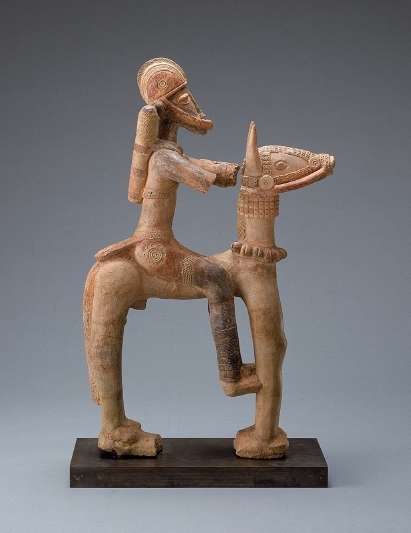
A terracotta figurine depicting a cavalry warrior of the Mali Empire (1240-1645 CE). 13th-15th century CE. (National Museum of African Art, Washington D.C.)

I’ve been meaning to read the story of Sundiata since I learned about him in a college Intro to African History class. So, when I started this project, I resolved to include this epic figure. I was not sure what to expect, other than a conquering hero and founder of empire. But I found the tale of a wise law-giver, mighty in both war and magic, honorable and fair-dealing in deed.

From the beginning, it was clear that the griots (the traditional historians and storytellers of the Mandinka) and I understood one another. Their purpose was promptly revealed as one close to my heart:

I teach kings the history of their ancestor so that the lives of the ancients might serve them as an example, for the world is old, but the future springs from the past

Sundiata, An Epic of Old Mali, Djibriltamsir Niane (G.D. Pickett, trans) (Pearson 2009), 3

Like many great stories, Sundiata’s tale began with a prophecy delivered by a travelling stranger. This hunter told a wise and kind king, Maghan Kon Fatta, of a hideous and magical Buffalo Woman he had encountered in his travels. If Maghan would follow his instructions and subdue the Buffalo Woman to make her his new wife, he would be assured of her a mighty king as a son. But when the son came, he seemed to have little promise. Although he was strong in the arms, the three year old boy rarely spoke and got around by crawling. He seemed interested in little but food. King Maghan continued to have faith the prophecy, but upon his death, palace intrigues left another wife, Sassouma, in control of a regency counsel with the aim to deny Sundiata his birthright.

By the time Sundiata reached seven years old, all seemed lost to his mother Sogalon. She was essentially exiled from the palace with her children. Her only solace was a small garden. But when she finally lashed out in frustration against Sundiata that he only sat and ate while Sassouma’s child brought her choice leaves from the forest, Sundiata rose and walked into the forest to bring her back an entire mature tree. From that point, Sundiata began to live and strong and active life on the path of the hunter. He assembled a band of other young hunters from neighboring territories with his skill and prowess.

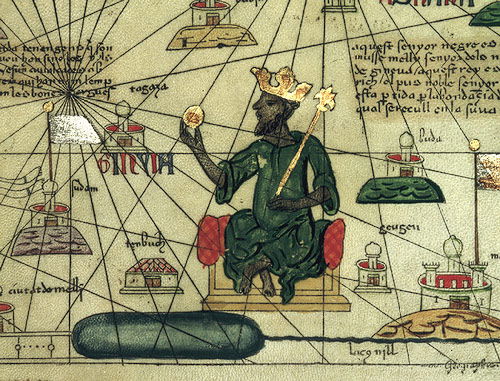
Sundiata’s great-nephew, Mansa Musa from the 1375 Catalan Atlas of the known world (mapamundi), drawn by Abraham Cresques of Mallorca

No longer able to use his infirmity against him, Sassouma turns to witchcraft to eliminate Sundiata. But Mandinka curses rely on attaching to an evil quality in the target, so the witches attempt to goad Sundiata into anger by stealing from his mother’s precious garden. Perceptive hunter that he is, Sundiata catches them in the act:

‘Stop, stop, poor old women,’ said Sundiata, ‘what is the matter with you to run away like this? This garden belongs to all.’

Straight away his companions and he filled the gourds of the old hags with leave, aubergines, and onions.

‘Each time you run short of condiments come to stock up here without

Sundiata, 25.

This is just the first of Sundiata’s generosity. At every turn throughout his rise, Sundiata shares the bounty of his prowess with others. Even after the witches tell Sundiata they were hired to kill him with their magic, he offers them an entire elephant he and his companions killed so that they will not suffer from foregoing the cattle Sassouma offered them for payment. At other times, he shares the bounty of later hunts, the spoils of battle, and the comforts of hospitality with strangers from all lands. Even more, he recalls the little desires of people he meets and he greets even the most humble by name and recalls their family, leading one watcher to remark, ” There’s one that will make a great king. He forgets nobody.” Id., 34.

When Sassouma’s favored son becomes king, Sogalon takes her family into exile in the kingdom of Ghana. It is there that Sundiata grows into an adult and takes up the ways of a warrior. In his first battle, the future king’s courage is evident:

[Sundiata] hurled himself on the enemy with such vehemence tht the king feared for his life, but Mansa Tounkara admired bravery too much to stop the son of Sogolon.

Id., 36-37.
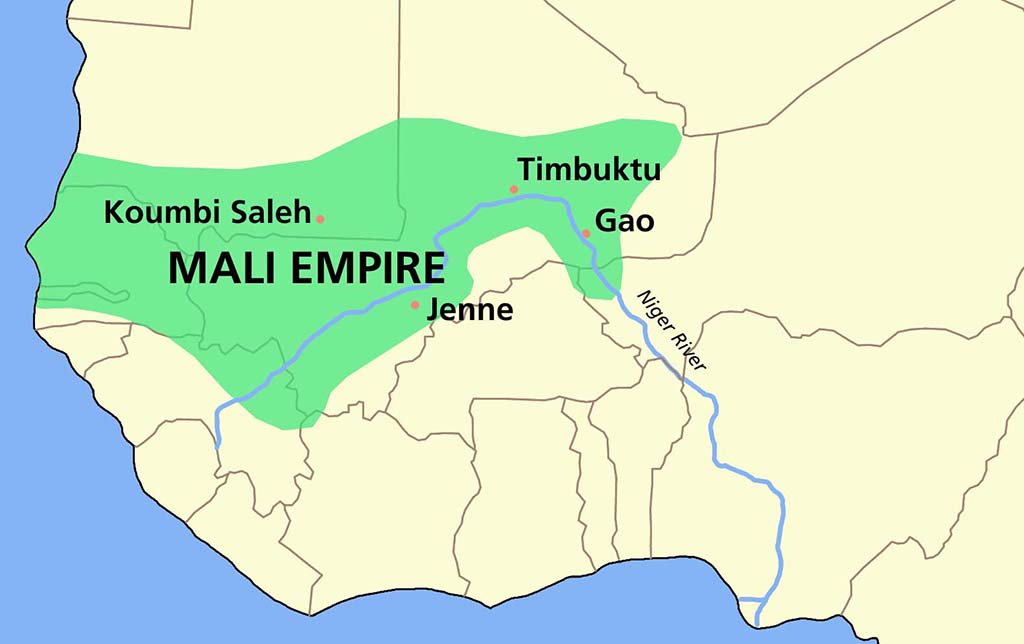
Map by Helt (CC BY-SA 3.0)

Eventually, the son of the Buffalo Woman learns that an evil wizard has taken power in his ancestral lands and is terrorizing the surrounding kingdoms, conquering lands all around. He assembles a force from the companions he has made and their countrymen to fight back against this wizard who wears the skin of men. But even in this quest to fulfill his destiny and take the throne, Sundiata is not motivated only by a search for glory and lordship. He also seeks to restore the countries of people disposed by the wizard:

‘I defend the weak, I defend the innocent, Fakoli. You have suffered an injustice so I will render you justice.’

Id., 61

I was thrilled by Sundiata’s story, as thrilled by it as I was disappointed by Digenis Akrites‘. Here was a hero who rose from unpromising origins—an apparently failed prophecy. He was sent into exile unjustly, earned a place in a foreign land though kindness, wit, and courage. And then returned, aided by loyal friends and commanding an army with skill, on a quest to protect the weak, restore justice, overcome evil, and take his destined place as king. This was knighthood as I could recognize it.

The griots who tell the story of Sundiata do not claim to tell the entire story or the entire truth. In fact, in several places, they claim outright that there are secrets known to the griots that should not be revealed to other people. But I did find the story true to the promise Maghan Kon Fatta made to his son when he presented him with a griot to be a companion:

‘From his mouth you will hear the history of your ancestors, you will learn the art of governing Mali according to the principles which our ancestors have bequeathed to us.’

Id., 17.

I’ll get into the principles Mansa Sundiate Keite established in another post. His reign left humanity with the great gift of a comprehesive constitution; one recognized as one of the world’s first charters of human rights.

But this is why I study these stories, in spite of the flaws and sins of all of our collective ancestors. Their acts were often hideous, their words could be the worst lies. But their principles—the high-minded and lofty things they assured us motivated their actions—those may yet bear us fruit.

Additional Sources

Arthur Szyk (1894-1951). The Scribe (1927), Paris
Arthur Szyk, CC BY-SA 4.0 https://creativecommons.org/licenses/by-sa/4.0, via Wikimedia Commons

I previously detailed seven sources for my thoughts on historical attitudes and views of elite warriors. In the intervening time, although I have not been posting, I haven’t stopped reading and thinking about chivalry and virtue.

The Book of Psalms – I didn’t want to ignore one of the fundamental books in the world tradition, but I’d rather stay clear of debates about the authorship of the Bible or get bogged down in another religious issue. After some review and study, I decided that the Book of Psalms was a way to touch upon that tradition without too much risk of straying into religious interpretation. The primary version I own is a King James Version, but I’ve also used the Online Parallel Bible to compare English translations to see if that raised any insights.

The Song of Roland – This is an 11th century epic poem in Old French about the events surrounding the Battle of Ronceveaux Pass in 778 C.E. in the time of Charlemagne. I am taking my selections from the 2011 Halcyon Press edition, which contains two English translations. I prefer the style of the translation by Léonce Rabillon, so that is the version I’ll use for quotations, unless the C.K. Moncreiff translation makes a point more clearly.

DR. L. LEGRAIN, CC0, via Wikimedia Commons

The Epic of Gilgamesh – often called the oldest recorded epic, the story of Gilgamesh is a foundational tale from ancient Mesopotamia. It is gathered from various tablets written in Old Babylonian or Akkadian and likely written after many years of oral transmission. I appreciate the short, clear poetry without overuse of archaisms in Peter Dyr’s 2013 translation presented in The Epic of Gilgamesh, the Teachings of Siduri and How Siduri’s Ancient Advice Can Help Guide Us to a Happier Life. (I found the quality of the analysis of the importance of Siduri in history seriously lacking. But the poetry is rendered beautifully and the story is faithfully related upon comparison to other translations.)

Plank, CC BY-SA 4.0 https://creativecommons.org/licenses/by-sa/4.0, via Wikimedia Commons

Sundiata, An Epic of Old Mali – This is the story of the founder of the Malinke (or Mandingo) Empire, Sundiata Keita, who reigned in the early 13th century. A history passed through the centuries by the griots, masters of an ancient oral tradition, the version I read was collected in the 20th Century by Djibriltamsir Niane and presented in English by G.D. Pickett. Sundiata occupies a place between the Muslim and indigenous Malinke traditions and represents a transition between the Ghana Empire and the Malinke in northwest Africa. As I will detail in an article dedicated to this story—which I had wanted to read for quite some time, but had not made time for until this project—the history of Sundiata reflects some commonalities in the qualities expected of elite warriors that I’ve identified in our European and Asian sources.

Sundiata was also the ruler who established the Manden Charter, considered the first charter of human rights and one of the world’s oldest comprehensive constitutions. The Manden Charter, which was recognized as part of the Intangible Cultural History of Humanity in 2009, will certainly become part of my future study.

Prowess Unrestrained

I started reading Digenes Akrites in translation by John Mavrogordato (1956; Oxford at the Clarendon Press) with keen interest. After all, I’d seen descriptions about how this was The Great Byzantine Romantic Epic that survived through storytelling to the 16th century and was all but lost until recovered in the 19th century. The other great chivalric stories were wonderful, but here’s where I could find a heroic image that could shape my portrayal. It was only more wonderful that the hero, Basil, was literally the son of two worlds and ruled the border; Digenes Akrites is a title rendered in English as “the two-race border lord” or “the Tyborn Borderer.” The borders of cultures have always intrigued me.

The opening lines promised to deliver the epic I craved. This is the story of Basil, “who had his strength as gift from God/ And overthrew all Syria/ Babylon, all Harziane/ Armenia, Kappadokia”. He overawed all manner of beasts and warriors mighty and brave. And the first books, which detail the exploits of the Emir, Basil’s Muslim father, and how he captured and was converted through love by Basil’s mother and came to be a good Roman through that same love, deliver a parentage worthy of a legendary figure.

The Borderer quickly demonstrated matchless Prowess. At twelve, he dispatched two bears with only his hands before running down a deer and tearing it in half and then killing a lion with his sword. Very quickly afterward, he single-handedly defeated the entire local force of bandits. Before even reaching the flower of adulthood, Basil absconded with a magnificent bride and destroyed her wealthy patrician father’s entire army, leaving only her father and brothers alive.

And when summoned by the Emperor for recognition, Basil showed his Loyalty, piety, Largesse, and intellectual mastery of virtue:

'Master, keep everything,' the boy replied, 
'Your love alone is quite enough for me. 
It is not right to be taking but rather giving; 
You have unmatched expenses in your army, 
I claim and I entreat your glory's power, 
To love obedience, pity the poor, 
Deliver from injustice the oppressed, 
Accord forgiveness to unwilling faults, 
Not to heed slanders, accept no injustice,
Scatter the heretics, confirm the orthodox. 
These, master, are the arms of righteousness, 
With which you can overcome all your enemies.'

Digenes Akrites, John Mavrogordato, trans (Oxford at the Clarendon, 1956) beginning line 2107
A miniature depicting the defeat of the Georgian king George I (“Georgios of Abasgia”) by the Byzantine emperor Basil II. Skylitzes Matritensis, fol. 195v.

In the fifth book, the Borderer entered the outside world. He left his father’s land and his own estate and traveled into Syria, seeking adventure. At an oasis, he came across a beautiful girl in a desperate plight. She was seduced away from her family by a captured Roman, who professed his love and promised her marriage, converting her to the Christian faith. But when the Roman was finally free, he took all the stolen property and horses and left this girl alone at the oasis, without family or even shoes. When Basil encountered the girl, her feet were bloody from fruitlessly trying to pick her way through the desert surrounding the oasis. Upon hearing her story, Basil swore to find the Roman and make him fulfil his promise of marriage.

And we set out to go to Coppermines
(That was a place near by in Syria)
I knew not what I was, I was all fire,
Passion increasing utterly within me;
So when we rested as for natural need—
My eyes with beauty and my hands with feeling,
My mouth with kisses and with words my hearing—
I started to do all of lawless action,
And every deed I wanted all was done.
By lawlessness our journey was defiled
By Satan's help and my soul's negligence, 
Although the woman much opposed the doing
Calling on God and on her parents' souls.

Id., beginning line 2410 (Emphasis added)

Basil, we are told, confesses this in his penitence to friends and strangers, ashamed of his act of adultery. Id., line 2186. He returned home to his wife and, haunted by his guilt of betraying her, relocated the entire household to the wilderness in search of a place to build his own homestead. Id., lines 2453-2461.

The reviewers I had read skipped over the events of the fifth book and focused on the sixth. But at that point, I had a bad taste in my mouth. Confronted with the first oppressed person he encountered, Basil proceeded to rape her, blame the rape on her and the Devil, force her to marry a person who had already deceived and abandoned her once, and then left the area. But Basil had entered the wilderness and I knew a fight with a dragon was coming, so there could still be some of what I craved.

There certainly was plenty of violence in the sixth book. Basil and his wife set up house in a tent in the wilderness a little way apart from their household. There, a serpent in the form of a youth tried to seduce the woman. But she immediately recognized him for what he was and called Basil. Upon Basil’s arrival, the serpent transformed into a three-headed, fire-breathing dragon, which the Borderer struck down with a single sword blow. The woman is then threatened by a lion, which Basil slaughters with similar efficiency. Then a horde of bandits attacked, all of which Basil easily defeated, chasing their cavalry on foot and armed only with a stick and a small shield. His Prowess overwhelmed every force against him.

The bandit leaders then stumbled upon Basil’s camp while trying to find their missing army. After Basil soundly beat these bandit captains, they decided to recruit the aid of Maximo, a warrior woman nearby descended from the Amazons who accompanied Alexander the Great back from India. Maximo lived nearby with a handpicked army of her own.

Maximo brought her army to attack, but quickly discovered the bandits were trying to trick her. She challenged Basil to single combat anyway. Basil skillfully charged through a river and lopped off Maximo’s spearhead and then the head of her horse, upon which she quickly surrendered. Then, after Basil destroyed the remaining army, Maximo begged him to fight her the next day so she could demonstrate her true skill at arms.

Basil dominated Maximo easily in the fight by disarming her and again cutting her horse in two. Then Basil and Maximo had sex in a grove of trees by the river. Basil left her there, begging him to stay. He returned to his wife, who was understandably suspicious. But Basil reassured his wife that he wounded Maximo and then delayed merely to dress her wound, “that I should not be blamed for killing a woman.” Id., line 3294.

When I said this the Girl had some relief,
Thinking the truth had been in what I said.
Then having taken the Girl's words to mind,
Myself all boiling over in much rage,
Forthwith I mounted as if for the chase,
And having caught I slew her ruthlessly, 
Adulteress...

Id., beginning line 3295

There were two more books to the story. Basil built a magnificent mansion on the banks of the Euphrates and increased his fame through nondescript conquests and feats of strength and athletics. And finally, Death claimed him through illness and Basil’s wife prayed herself to death trying to save him, the two dying nearly at the same instant.

Digenes Akrites is for me a warning that the stories of past heroes are not full of light. And that not every storied elite warrior is knightly. Basil the Borderer was a warrior of undoubted Prowess. He slew hordes of enemies and slaughtered dangerous beasts. But when it counted, he proved he lacked the essentials of Chivalry. When faced with a vulnerable and oppressed person, he raped her. And he saw his only crime as adultery. Afterward, he lied to his wife about his dalliance with Maximo and then snuck off in the night to murder Maximo, blaming her as an adulteress.

I expected a redemption arc. But it never came. Instead, Basil’s overwhelming Prowess prevents him from facing any consequences but the inevitability of death. And even at death, Basil gets defined entirely by his Prowess. He does not even get the return to humanity on his deathbed that Achilles experienced when Priam begged for the return of Hector’s body. In the end, the Borderer lived and died nothing but a supremely gifted killer, with only a legacy of marble and blood.

May the pursuit of virtue spare me such a legacy.

Prowess, Courage, & Embracing Risk

The inevitable risk of a contest is the possibility of losing. This fundamentally underlies the centrality of Prowess in Chivalry. In order to demonstrate Prowess, one must risk defeat. For the ancient or medieval warrior, this meant death, capture and ransom, or submission to slavery. For the elite warriors, any of those meant suffering for their wives, children, households, vassals, or entire nation.

“Illuminated Manuscript, Gloss on The lamentations of Jeremiah, Walters Manuscript W.30, fol. 3r” by Walters Art Museum Illuminated Manuscripts is marked with CC0 1.0

And even the mightiest heroes of legend were not immune to this doubt. As the battle turned against the Greeks and they were driven back against their beachhead, the clever Odysseus was caught all alone:

Odysseus probed his own great fighting heart: 
"Oh dear god, what becomes of Odysseus now? 
A disgraceful thing if I should break and run, 
fearing their main force—but it's far worse
if I'm taken all alone. Look, Zeus just drove
the rest of my comrades off in panic flight.

The Iliad, Book Eleven, Robert Fagles trans., Penguin (1990).

So how should a warrior deal with this fear? Could they trust a strong arm, a sharp spear, and a lifetime of training to bring victory? Our sources suggest the warriors didn’t think so. Time after time before the walls of Troy, blooded heroes fell to their foes in gruesome testimony to the horror of war. Even being the son of Zeus did not avail Sarpedon when he faced the onslaught of the young mortal Patroclus and was left to be carried away to his grieving father.

Mere might or even hours of training and expertise could not assure a victory. Even these heroes of legend had to face the fact that their opponent held the power to lay them on the field. Hector reminded Achilles of this fact before their final encounter:

"Don't think for a moment, Achilles, son of Peleus, 
you can frighten me with words like a child, a fool—
I'm an old hand myself at trading taunts and insults.
Well I know you are brave and I am far weaker.
True—but all lies in the lap of the great god.
Weaker I am, but I still might take your life
with one hurl of a spear—my weapon can cut too, 
long before now its point has found its mark." 

Id., Book Twenty

And this leads to the importance of Courage to accompany Prowess. At the point of contact, where the knightly duty is grimly done, talent and skill can go only so far. In that contest, there is always the risk of loss. A fighter cannot go to the hazard assured of coming back the same. After all, the opponent is also a person of skill and worth, seeking their best to overcome. Their chance of victory cannot be discarded. But concentrating on the possibility of loss deprives the warrior of the focus necessary to overcome.

Courage intermediates in that conflict. It is what gives the person at arms the inner strength to exercise their Prowess. Prowess wants to win. It abhors the idea of losing. Courage is like the armor that protects Prowess as it enters the fray; the thing that allows talent and training to engage and project the ideals of Chivalry in the world through combat. Courage shelters Prowess as it passes through the storms of chance.

For Tsunetomo, this was at the core of the samurai’s business:

It is a principle of the art of war that one should simply lay down his life and strike. If one’s opponent also does the same, it is an even match. Defeating one’s opponent is then a matter of faith and destiny.

Tsunetomo Yamamoto, The Hagakure, William Scott Wilson, trans. Kodansha International (1979), 157.

I think this is also part of the essence of what Musashi meant when he wrote, “the Way of the warrior is the resolute acceptance of death.” Miyamoto Musashi, A Book of Five Rings, Victor Harris, trans., The Overlook Press (1982). And I believe it is certainly related to Sun Tzu’s comment that “Being unconquerable lies with yourself; being conquerable lies with the enemy. Thus one who excels in warfare is able to make himself unconquerable, but cannot necessarily cause the enemy to be conquerable.” Sun Tzu, The Art of War, Ralph D. Sawyer, trans., Barnes & Noble (1994).

As for Odysseus, that famous tactician, for all the twists and cutbacks of his mind, came to a straightforward conclusion:

"But why debate, my friend, why thrash things out? 
Cowards, I know, would quit the fighting now
but the man who wants to make his mark in war
must stand his ground and brace for all his worth—
suffer his wounds or wound his man to death." 

The Iliad, Book Eleven, Robert Fagles trans., Penguin (1990).

Love in Public

Out with it now, Calchas. Reveal the will of god, 
whatever you may know. And I swear by Apollo
dear to Zeus, the power you pray to, Calchas, 
when you reveal god's will to the Argives, no one, 
not while I am alive and see the light on earth, no one, 
will lay his heavy hands on you by the hollow ships. 
None among all the armies. Not even if you mean 
Agamemnon here who claims to be, by far, 
the best of the Achaeans

The Iliad, Book One
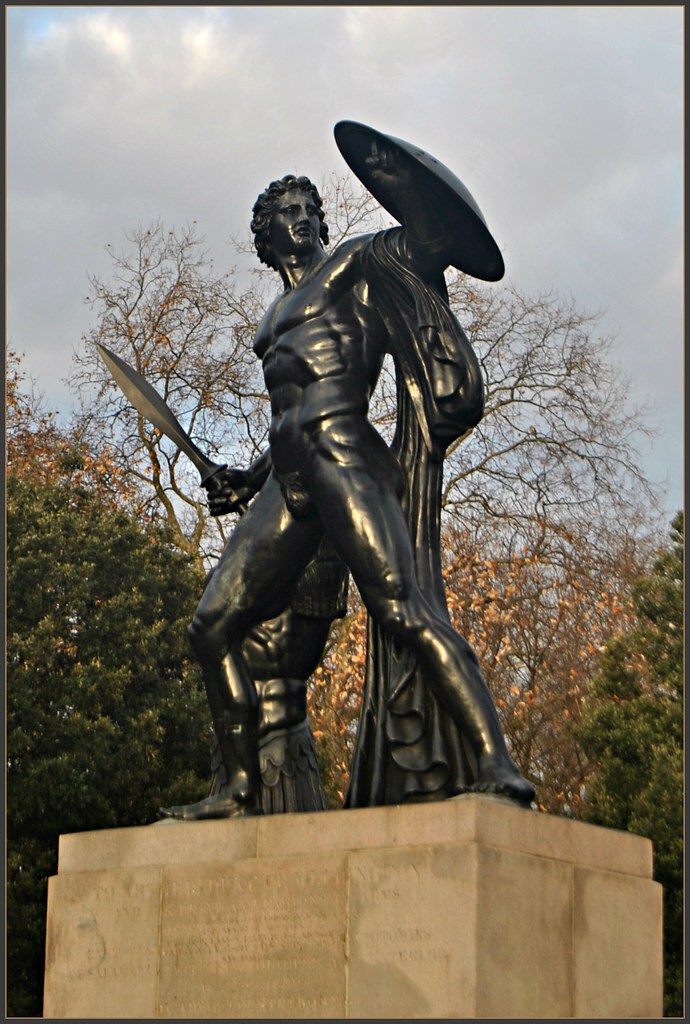
“Statue of Achilles London” by Loco Steve is licensed under CC BY-SA 2.0

Cornel West has exhorted us to “never forget that justice is what love looks like in public.” And fewer displays have been more public than the stand of Achilles on the beachhead in sight of the walls of Troy. His Greek comrades falling all around him from a mysterious plague, Achilles sought the cause of the vicious malady that had befallen them. When the prophet Calchas was hesitant to pronounce the omens he had seen because someone powerful wouldn’t appreciate the sign he had read, Achilles stretched his hand and protection over Calchas in the passage above.

It is easy to read the Iliad with frustration at Achilles. His insolent and prideful refusal to fight because a slave was taken away from him certainly doesn’t endear him to many. But at this moment, before his wrath has overtaken him and the machinations of the Olympians have taken over the war, Achilles is exhibiting Justice. He is taking his love for the dying Achaeans and for Calchas and the truth he represents and wielding it as a shield against even the most powerful warlord present. Achilles’ challenge can be made very simple in modern terms: If anyone wants to harm Calchas for what he’s about to reveal, it will be over Achilles’ dead body.

In modern times, justice is spoken of as synonymous with law. And we often have a concept of justice being something that is handed down from on high. But in a chivalric sense, justice cannot be simply obeisance to power. Authority is too often taken by force and wielded arbitrarily to be given that kind of place. Chivalric concepts of justice come with the obligation to stand up to power when power is wielded unjustly. And that obligation comes with the risk of being struck down when the power is too mighty. In this sense, the love of others and the justice to which they are entitled must overcome the love of self if one is to be knightly.

And this is not only a Western concept. In the Hagakure, the concept of compassion (in Japanese: 仁) appears frequently. For example – “[I]f a warrior makes loyalty and piety one load and courage and compassion another, and carries these 24 hours a day until his shoulders wear out, he will be a samurai.” (Hagakure, from the 6th chapter) This intimate link between courage and compassion—being a single load to carry—demonstrates the connection between this kind of love and justice. For the chivalrous, this love must come with the heart to take action and face risk.

If these examples are leading the right way, then Cornel West’s quote speaks to the heart of the knightly.

[A note on 仁 (Japanese jin; Chinese ren) and its translation. I do not read Japanese and I rely on translations for these Japanese works. But I am cognizant of the problems of translation, so I researched what character the translator rendered as the English word “compassion.” As it happens, 仁 was brought to Japan as part of Confucianism and integrated into Bushido. According to Dubs H, Homer. “The Development of Altruism in Confucianism” Apr. 1951: 48-55 JSTOR Oxford University, Confucius himself defined 仁 with reference to the ordinary word for love and said it meant to “love others.” Other common words used for this concept are “benevolence” “perfect virtue” and “goodness.” Confucius also said of 仁, “Now the man of perfect virtue, wishing to be established himself, seeks also to establish others; wishing to be enlarged himself, he seeks also to enlarge others.”

To me, this seems sufficient to support this reading from Hagakure and to feel that I am sufficiently keeping with the spirit of that work.]

“For the love of King Alfonso, who banished me”

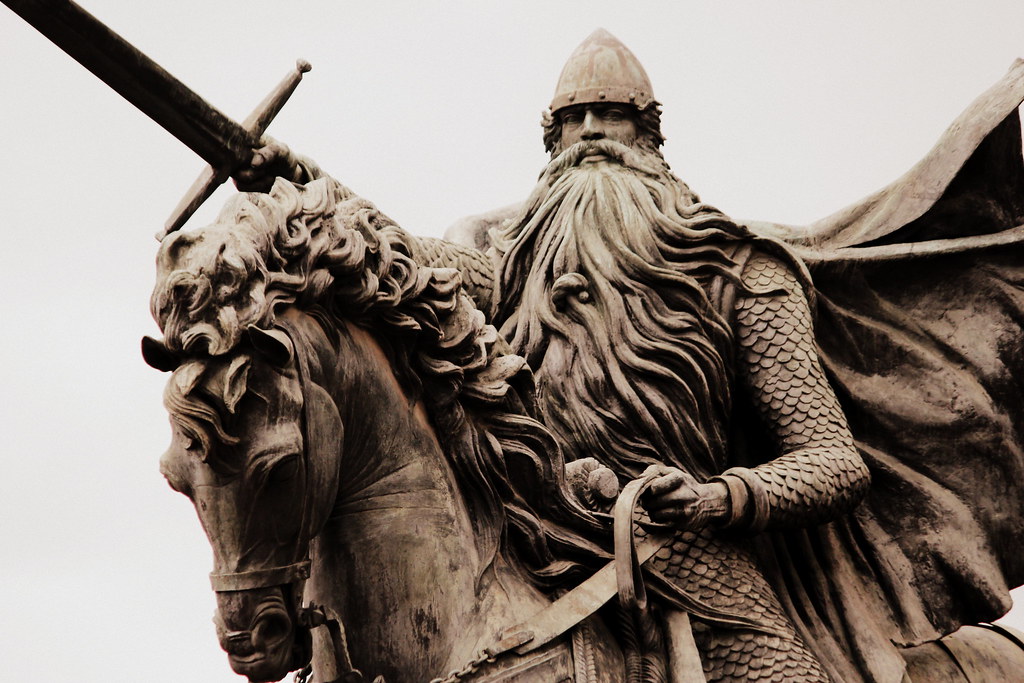
“Taken in 1980’s San Diego, Balboa Park – silhouette of El Cid on horse statue with banner” by Paul L Dineen is licensed under CC BY 2.0

I’ve mentioned that Loyalty is a tough concept. As a lawyer, a husband, and a squire, one fact is never far from my mind—Loyalty cannot mean very much if it binds one only when it is convenient. To the ancient warriors and their chroniclers, this was also evident.

In the Hagakure, Nakano Jin’emon is quoted as having “constantly said, ‘A person who serves when treated kindly by the master is not a retainer. But one who serves when the master is being heartless and unreasonable is a retainer.”

And in The Poem of The Cid, Ruy Diaz repeatedly reaffirms his loyalty to King Alfonso, even though the latter has unjustly exiled him from the kingdom. The first major instance is just after his exile, when the Campeador and his small band capture the keep of Castejon, just across the border from King Alfonso’s domain. Even though this is safety, and hard won, Ruy Diaz abandons his prize after only one night: “[F]or King Alfonso is close by and may attack us… We will depart in the morning, for I will not fight my lord King Alfonso.”

To these warriors, loyalty to their lords was not severed by even extreme behavior. Notice how serious these situations are. Tsunetomo speaks of the master as “heartless” and El Cid was forced to flee a decree making him an outlaw and placing him at risk of robbery and death. But still, these extremes do not release them from their bonds of loyalty. In the second canto, Ruy Diaz even declares:

For the love of King Alfonso who banish me no scissors shall touch my beard, nor shall a single hair of it be cut, let Moors and Christians say what they will.

The Poem of El Cid, Canto Two: The Wedding

It would be easy to interpret these stories as reinforcing the power structure. In a modern view, this kind of loyalty is toxic. Loyalty is a duty. Duties are generally reciprocal and a breach of that arrangement by one person releases the other. In medieval terms, this was also legally true; a lord and vassal exchanged promises and the lord gave property to secure the vassal’s loyalty. A political interpretation of both examples would be that the religious (Tsunetomo had given up being a samurai and become a monk after being forbidden to practice seppuku) and artistic elite must reinforce the power structure.

But Tsunetomo lived in hermitage and was beyond the usual reach of secular authorities and was largely irrelevant to them. And Ruy Diaz conquered in battle after battle; in the poem he is unsurpassed in battle. Neither had any reason to reinforce the power structure. And El Cid is presented in a way that makes it clear it would be within his power to overcome King Alfonso in a military struggle. So what is it that causes these people to prize loyalty so highly?

I think one way to understand this behavior is to consider Loyalty as a virtue to possess, rather than a duty to uphold. One can be released from or can discharge a duty. It is possible to be “loyal enough” or for the law and society to find a clean boundary for the end of a duty of loyalty. In that model, abuse can justify a breach of loyalty (consider the model of the American Declaration of Independence for example, under which the actions of the Crown were argued to be so egregious that those colonies had been released from their duty of loyalty).

But if Loyalty is a virtue, then the law and custom cannot set the bounds. If we take as true that perfect virtue is a rare standard to meet, then we have to understand that a person pursuing that virtue will strive for a standard beyond the ordinary. To that person, although the release of the bounds of duty is sufficient for others, it is not the personal standard. To remain loyal in the face of hardship is, for this person, not because of the relationship or duty; it is a personal obligation. To remain loyal in the face of injustice or heartlessness isn’t about the relationship with the master or the king. It is about the journey and the striving of the warrior toward perfect Loyalty.

This raises questions: For Tsunetomo and Ruy Diaz, there seems to be no limit to their loyalty. But where is my limit, if any? Is it an objective rationale that can be applied without regard to the personalities involved, or is that a natural impossibility or a fundamental injustice? But those questions are for another day.

The Sources

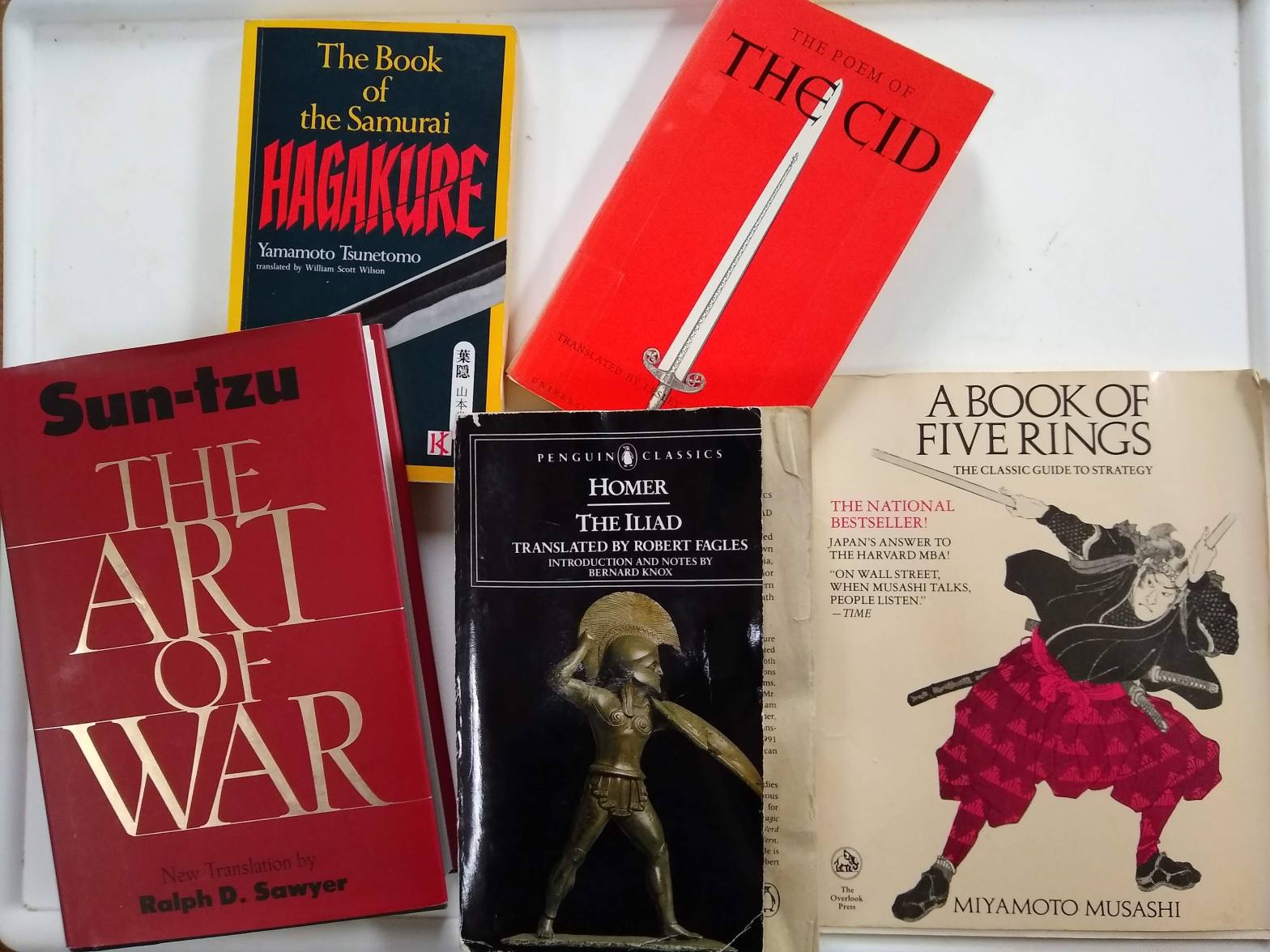
This endeavor will begin with a small sampling of sources with which I am already familiar and for which I already have notes. When I began taking notes, it was not with the idea that I’d ever share these notes or my thoughts on them outside my SCA household. This began with a list of books recommended to me by my knight, who was the first person to put a practice sword in my hand and teach me what to do with it. As time goes by, I will hopefully expand to include sources from around the world and through many cultures.

The Illiad – the version I use is the 1990 Penguin Books edition of Robert Fagles translation. Traditionally considered to have been composed by Homer for oral recitation, the Illiad tells the story of just a few days near the end of the legendary Trojan War. The theme, as the first line of the epic tells us, is the rage of Achilles and how it caused ruin among the ranks of the Greeks massed before the walls of Troy (Illium). It is one of the foundational stories of the Western tradition. For my purposes, it gives a bloody and grim vision of ancient warfare and the beliefs of those who fought in it.

The Art of War – I have the 1994 Barnes & Noble edition of this ancient work, translated by Ralph D. Sawyer. This treatise on military strategy gives insight into what an ancient scholar of Chinese warfare advised for mass battles. Philosophers and corporate spokespeople have repeatedly interpreted lessons in many fields from its pages. I’d have to be a fool to think I shouldn’t try to do the same.

The Poem of The Cid – my version is Lesley Byrd Simpson’s 1957 University of California Press translation. The story itself is historical. The titular Cid is a historical knight of Castille and Leon, Ruy Diaz de Bivar, who lived and fought in the late 11th century in modern-day Spain. Already a legend of warfare by the time the tale begins, the knight begins the story under sentence of exile from his king. With only those few warriors he was able to rally to his banner on the way out of his home kingdom and funds scammed from a pair of moneylenders, the Cid conquers most of the remaining pennisula and wins his way back into King Alfonzo’s favor. Along the way, he shows different aspects of knighthood through word and deed.

The Demon’s Sermon on the Martial Arts – I have an e-book edition of William Scott Wilson’s 2006 translation from Shambhala Publications, Inc. The author is Niwa Jurozaemon Tadaaki, a samurai who lived through the transition from the 17th to 18th century. It is presented as a series of remarks from a collection of tengu. These demon figures lecture to the narrator on the inner secrets of true martial mastery.

The Unfettered Mind – William Scott Wilson also translated this 2012 Shambhala Publications edition of Takuan Soho’s Zen teachings on the subject of mastering the way of the sword. The author was a Zen monk of many years and voluminous writings. The Unfettered Mind is made up of two letters to samurai and another essay aimed at the samurai class that seek to unify the practice of Zen and the way of the warrior. These essays on mastering swordsmanship and the self were written to guide samurai in their application of virtue during a martial life.

A Book of Five Rings – written by the legendary duelist Miyamoto Musashi in the weeks leading up to his death in 1645, A Book of Five Rings is the culmination of the philosophy of the unified way of strategy for all things derived through more than 60 duels to the death. I have Victor Harris’ 1974 translation in a 1982 paperback version from The Overlook Press. This might be the most immediately useful for technical swordplay of my sources, but re-reading it has taught me that there is much more in this volume than it first appears.

The Book of the Samurai: Hagakure – I have Wilson Scott Wilson’s 1979 translation from Kodansha International. The Hagakure was dictated by retired samurai Yamamoto Tsunetomo sometime after the year 1700. Like the other Japanese sources, the Hagakure wrestles with the place of a warrior class during an extended period of peace. In that struggle, the Hagakure sets forth a vision of a lifestyle driven by the never-ending pursuit of virtue.

The Point of it All

There is one transcending level, and this is the most excellent of all. That person is aware of the endlessness of entering deeply into a certain Way and never thinks of himself as having finished. . . Throughout your life advance daily, becoming more skillful than today. This is never ending.

from The Hagakure, Yamamoto Tsunetomo (William Scott Wilson, trans.), Kodansha America, Inc. (1983)

The entire point of this blog is improvement on the road I have chosen. By studying the stories, acts, and writings of noble warriors from the past, I hope to clarify my own thoughts about a life in harness and what it means for the rest of my life.

The Hagakure is especially instructive to someone in modern life. Tsunetomo wrote about a class of warriors who were all but forbidden to fight. One of his goals was to explain what it meant to hold the values of this culture’s cult of chivalry when there were no opportunities to put oneself to the test of the sword. We’ll return to his book often over time. What does it mean to hold a warrior’s values and live in peace?