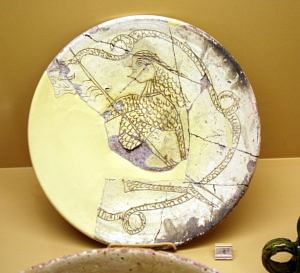
I started reading Digenes Akrites in translation by John Mavrogordato (1956; Oxford at the Clarendon Press) with keen interest. After all, I’d seen descriptions about how this was The Great Byzantine Romantic Epic that survived through storytelling to the 16th century and was all but lost until recovered in the 19th century. The other great chivalric stories were wonderful, but here’s where I could find a heroic image that could shape my portrayal. It was only more wonderful that the hero, Basil, was literally the son of two worlds and ruled the border; Digenes Akrites is a title rendered in English as “the two-race border lord” or “the Tyborn Borderer.” The borders of cultures have always intrigued me.
The opening lines promised to deliver the epic I craved. This is the story of Basil, “who had his strength as gift from God/ And overthrew all Syria/ Babylon, all Harziane/ Armenia, Kappadokia”. He overawed all manner of beasts and warriors mighty and brave. And the first books, which detail the exploits of the Emir, Basil’s Muslim father, and how he captured and was converted through love by Basil’s mother and came to be a good Roman through that same love, deliver a parentage worthy of a legendary figure.
The Borderer quickly demonstrated matchless Prowess. At twelve, he dispatched two bears with only his hands before running down a deer and tearing it in half and then killing a lion with his sword. Very quickly afterward, he single-handedly defeated the entire local force of bandits. Before even reaching the flower of adulthood, Basil absconded with a magnificent bride and destroyed her wealthy patrician father’s entire army, leaving only her father and brothers alive.
And when summoned by the Emperor for recognition, Basil showed his Loyalty, piety, Largesse, and intellectual mastery of virtue:
'Master, keep everything,' the boy replied,
'Your love alone is quite enough for me.
It is not right to be taking but rather giving;
You have unmatched expenses in your army,
I claim and I entreat your glory's power,
To love obedience, pity the poor,
Deliver from injustice the oppressed,
Accord forgiveness to unwilling faults,
Not to heed slanders, accept no injustice,
Scatter the heretics, confirm the orthodox.
These, master, are the arms of righteousness,
With which you can overcome all your enemies.'

Digenes Akrites, John Mavrogordato, trans (Oxford at the Clarendon, 1956) beginning line 2107

In the fifth book, the Borderer entered the outside world. He left his father’s land and his own estate and traveled into Syria, seeking adventure. At an oasis, he came across a beautiful girl in a desperate plight. She was seduced away from her family by a captured Roman, who professed his love and promised her marriage, converting her to the Christian faith. But when the Roman was finally free, he took all the stolen property and horses and left this girl alone at the oasis, without family or even shoes. When Basil encountered the girl, her feet were bloody from fruitlessly trying to pick her way through the desert surrounding the oasis. Upon hearing her story, Basil swore to find the Roman and make him fulfil his promise of marriage.
And we set out to go to Coppermines
(That was a place near by in Syria)
I knew not what I was, I was all fire,
Passion increasing utterly within me;
So when we rested as for natural need—
My eyes with beauty and my hands with feeling,
My mouth with kisses and with words my hearing—
I started to do all of lawless action,
And every deed I wanted all was done.
By lawlessness our journey was defiled
By Satan's help and my soul's negligence,
Although the woman much opposed the doing
Calling on God and on her parents' souls.

Id., beginning line 2410 (Emphasis added)
Basil, we are told, confesses this in his penitence to friends and strangers, ashamed of his act of adultery. Id., line 2186. He returned home to his wife and, haunted by his guilt of betraying her, relocated the entire household to the wilderness in search of a place to build his own homestead. Id., lines 2453-2461.
The reviewers I had read skipped over the events of the fifth book and focused on the sixth. But at that point, I had a bad taste in my mouth. Confronted with the first oppressed person he encountered, Basil proceeded to rape her, blame the rape on her and the Devil, force her to marry a person who had already deceived and abandoned her once, and then left the area. But Basil had entered the wilderness and I knew a fight with a dragon was coming, so there could still be some of what I craved.
There certainly was plenty of violence in the sixth book. Basil and his wife set up house in a tent in the wilderness a little way apart from their household. There, a serpent in the form of a youth tried to seduce the woman. But she immediately recognized him for what he was and called Basil. Upon Basil’s arrival, the serpent transformed into a three-headed, fire-breathing dragon, which the Borderer struck down with a single sword blow. The woman is then threatened by a lion, which Basil slaughters with similar efficiency. Then a horde of bandits attacked, all of which Basil easily defeated, chasing their cavalry on foot and armed only with a stick and a small shield. His Prowess overwhelmed every force against him.
The bandit leaders then stumbled upon Basil’s camp while trying to find their missing army. After Basil soundly beat these bandit captains, they decided to recruit the aid of Maximo, a warrior woman nearby descended from the Amazons who accompanied Alexander the Great back from India. Maximo lived nearby with a handpicked army of her own.
Maximo brought her army to attack, but quickly discovered the bandits were trying to trick her. She challenged Basil to single combat anyway. Basil skillfully charged through a river and lopped off Maximo’s spearhead and then the head of her horse, upon which she quickly surrendered. Then, after Basil destroyed the remaining army, Maximo begged him to fight her the next day so she could demonstrate her true skill at arms.
Basil dominated Maximo easily in the fight by disarming her and again cutting her horse in two. Then Basil and Maximo had sex in a grove of trees by the river. Basil left her there, begging him to stay. He returned to his wife, who was understandably suspicious. But Basil reassured his wife that he wounded Maximo and then delayed merely to dress her wound, “that I should not be blamed for killing a woman.” Id., line 3294.
When I said this the Girl had some relief,
Thinking the truth had been in what I said.
Then having taken the Girl's words to mind,
Myself all boiling over in much rage,
Forthwith I mounted as if for the chase,
And having caught I slew her ruthlessly,
Adulteress...

Id., beginning line 3295
There were two more books to the story. Basil built a magnificent mansion on the banks of the Euphrates and increased his fame through nondescript conquests and feats of strength and athletics. And finally, Death claimed him through illness and Basil’s wife prayed herself to death trying to save him, the two dying nearly at the same instant.
Digenes Akrites is for me a warning that the stories of past heroes are not full of light. And that not every storied elite warrior is knightly. Basil the Borderer was a warrior of undoubted Prowess. He slew hordes of enemies and slaughtered dangerous beasts. But when it counted, he proved he lacked the essentials of Chivalry. When faced with a vulnerable and oppressed person, he raped her. And he saw his only crime as adultery. Afterward, he lied to his wife about his dalliance with Maximo and then snuck off in the night to murder Maximo, blaming her as an adulteress.
I expected a redemption arc. But it never came. Instead, Basil’s overwhelming Prowess prevents him from facing any consequences but the inevitability of death. And even at death, Basil gets defined entirely by his Prowess. He does not even get the return to humanity on his deathbed that Achilles experienced when Priam begged for the return of Hector’s body. In the end, the Borderer lived and died nothing but a supremely gifted killer, with only a legacy of marble and blood.
May the pursuit of virtue spare me such a legacy.
 Quills and Quintains