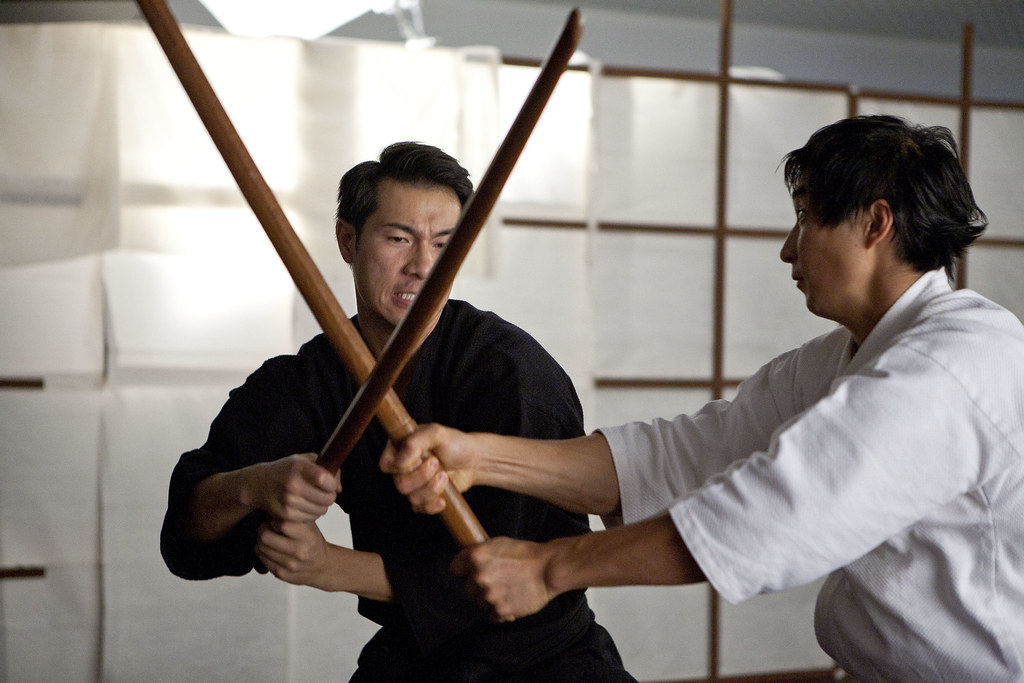
The inevitable risk of a contest is the possibility of losing. This fundamentally underlies the centrality of Prowess in Chivalry. In order to demonstrate Prowess, one must risk defeat. For the ancient or medieval warrior, this meant death, capture and ransom, or submission to slavery. For the elite warriors, any of those meant suffering for their wives, children, households, vassals, or entire nation.

And even the mightiest heroes of legend were not immune to this doubt. As the battle turned against the Greeks and they were driven back against their beachhead, the clever Odysseus was caught all alone:
Odysseus probed his own great fighting heart:
"Oh dear god, what becomes of Odysseus now?
A disgraceful thing if I should break and run,
fearing their main force—but it's far worse
if I'm taken all alone. Look, Zeus just drove
the rest of my comrades off in panic flight.

The Iliad, Book Eleven, Robert Fagles trans., Penguin (1990).
So how should a warrior deal with this fear? Could they trust a strong arm, a sharp spear, and a lifetime of training to bring victory? Our sources suggest the warriors didn’t think so. Time after time before the walls of Troy, blooded heroes fell to their foes in gruesome testimony to the horror of war. Even being the son of Zeus did not avail Sarpedon when he faced the onslaught of the young mortal Patroclus and was left to be carried away to his grieving father.

Mere might or even hours of training and expertise could not assure a victory. Even these heroes of legend had to face the fact that their opponent held the power to lay them on the field. Hector reminded Achilles of this fact before their final encounter:
"Don't think for a moment, Achilles, son of Peleus,
you can frighten me with words like a child, a fool—
I'm an old hand myself at trading taunts and insults.
Well I know you are brave and I am far weaker.
True—but all lies in the lap of the great god.
Weaker I am, but I still might take your life
with one hurl of a spear—my weapon can cut too,
long before now its point has found its mark."

Id., Book Twenty
And this leads to the importance of Courage to accompany Prowess. At the point of contact, where the knightly duty is grimly done, talent and skill can go only so far. In that contest, there is always the risk of loss. A fighter cannot go to the hazard assured of coming back the same. After all, the opponent is also a person of skill and worth, seeking their best to overcome. Their chance of victory cannot be discarded. But concentrating on the possibility of loss deprives the warrior of the focus necessary to overcome.
Courage intermediates in that conflict. It is what gives the person at arms the inner strength to exercise their Prowess. Prowess wants to win. It abhors the idea of losing. Courage is like the armor that protects Prowess as it enters the fray; the thing that allows talent and training to engage and project the ideals of Chivalry in the world through combat. Courage shelters Prowess as it passes through the storms of chance.
For Tsunetomo, this was at the core of the samurai’s business:
It is a principle of the art of war that one should simply lay down his life and strike. If one’s opponent also does the same, it is an even match. Defeating one’s opponent is then a matter of faith and destiny.
Tsunetomo Yamamoto, The Hagakure, William Scott Wilson, trans. Kodansha International (1979), 157.
I think this is also part of the essence of what Musashi meant when he wrote, “the Way of the warrior is the resolute acceptance of death.” Miyamoto Musashi, A Book of Five Rings, Victor Harris, trans., The Overlook Press (1982). And I believe it is certainly related to Sun Tzu’s comment that “Being unconquerable lies with yourself; being conquerable lies with the enemy. Thus one who excels in warfare is able to make himself unconquerable, but cannot necessarily cause the enemy to be conquerable.” Sun Tzu, The Art of War, Ralph D. Sawyer, trans., Barnes & Noble (1994).
As for Odysseus, that famous tactician, for all the twists and cutbacks of his mind, came to a straightforward conclusion:
"But why debate, my friend, why thrash things out?
Cowards, I know, would quit the fighting now
but the man who wants to make his mark in war
must stand his ground and brace for all his worth—
suffer his wounds or wound his man to death."

The Iliad, Book Eleven, Robert Fagles trans., Penguin (1990).
 Quills and Quintains