Out with it now, Calchas. Reveal the will of god,
whatever you may know. And I swear by Apollo
dear to Zeus, the power you pray to, Calchas,
when you reveal god's will to the Argives, no one,
not while I am alive and see the light on earth, no one,
will lay his heavy hands on you by the hollow ships.
None among all the armies. Not even if you mean
Agamemnon here who claims to be, by far,
the best of the Achaeans

The Iliad, Book One
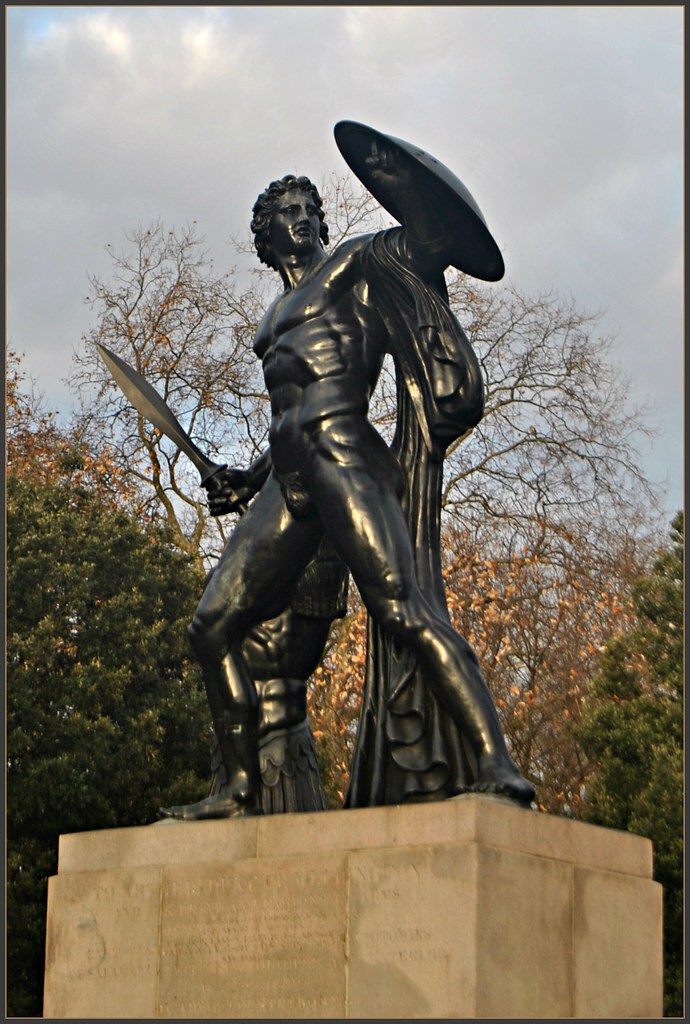
Cornel West has exhorted us to “never forget that justice is what love looks like in public.” And fewer displays have been more public than the stand of Achilles on the beachhead in sight of the walls of Troy. His Greek comrades falling all around him from a mysterious plague, Achilles sought the cause of the vicious malady that had befallen them. When the prophet Calchas was hesitant to pronounce the omens he had seen because someone powerful wouldn’t appreciate the sign he had read, Achilles stretched his hand and protection over Calchas in the passage above.
It is easy to read the Iliad with frustration at Achilles. His insolent and prideful refusal to fight because a slave was taken away from him certainly doesn’t endear him to many. But at this moment, before his wrath has overtaken him and the machinations of the Olympians have taken over the war, Achilles is exhibiting Justice. He is taking his love for the dying Achaeans and for Calchas and the truth he represents and wielding it as a shield against even the most powerful warlord present. Achilles’ challenge can be made very simple in modern terms: If anyone wants to harm Calchas for what he’s about to reveal, it will be over Achilles’ dead body.
In modern times, justice is spoken of as synonymous with law. And we often have a concept of justice being something that is handed down from on high. But in a chivalric sense, justice cannot be simply obeisance to power. Authority is too often taken by force and wielded arbitrarily to be given that kind of place. Chivalric concepts of justice come with the obligation to stand up to power when power is wielded unjustly. And that obligation comes with the risk of being struck down when the power is too mighty. In this sense, the love of others and the justice to which they are entitled must overcome the love of self if one is to be knightly.
And this is not only a Western concept. In the Hagakure, the concept of compassion (in Japanese: 仁) appears frequently. For example – “[I]f a warrior makes loyalty and piety one load and courage and compassion another, and carries these 24 hours a day until his shoulders wear out, he will be a samurai.” (Hagakure, from the 6th chapter) This intimate link between courage and compassion—being a single load to carry—demonstrates the connection between this kind of love and justice. For the chivalrous, this love must come with the heart to take action and face risk.
If these examples are leading the right way, then Cornel West’s quote speaks to the heart of the knightly.
[A note on 仁 (Japanese jin; Chinese ren) and its translation. I do not read Japanese and I rely on translations for these Japanese works. But I am cognizant of the problems of translation, so I researched what character the translator rendered as the English word “compassion.” As it happens, 仁 was brought to Japan as part of Confucianism and integrated into Bushido. According to Dubs H, Homer. “The Development of Altruism in Confucianism” Apr. 1951: 48-55 JSTOR Oxford University, Confucius himself defined 仁 with reference to the ordinary word for love and said it meant to “love others.” Other common words used for this concept are “benevolence” “perfect virtue” and “goodness.” Confucius also said of 仁, “Now the man of perfect virtue, wishing to be established himself, seeks also to establish others; wishing to be enlarged himself, he seeks also to enlarge others.”
To me, this seems sufficient to support this reading from Hagakure and to feel that I am sufficiently keeping with the spirit of that work.]
 Quills and Quintains