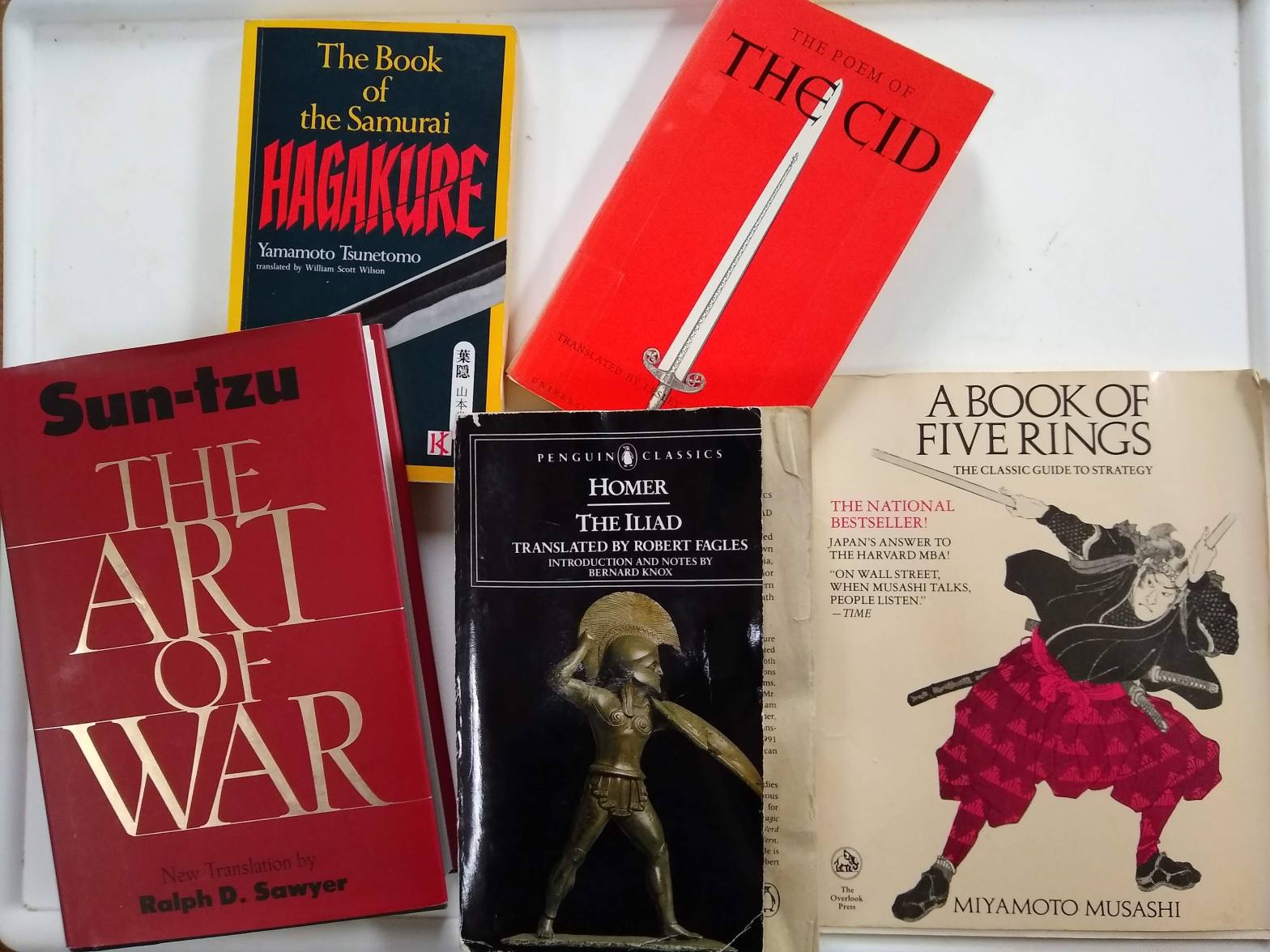

This endeavor will begin with a small sampling of sources with which I am already familiar and for which I already have notes. When I began taking notes, it was not with the idea that I’d ever share these notes or my thoughts on them outside my SCA household. This began with a list of books recommended to me by my knight, who was the first person to put a practice sword in my hand and teach me what to do with it. As time goes by, I will hopefully expand to include sources from around the world and through many cultures.
The Illiad – the version I use is the 1990 Penguin Books edition of Robert Fagles translation. Traditionally considered to have been composed by Homer for oral recitation, the Illiad tells the story of just a few days near the end of the legendary Trojan War. The theme, as the first line of the epic tells us, is the rage of Achilles and how it caused ruin among the ranks of the Greeks massed before the walls of Troy (Illium). It is one of the foundational stories of the Western tradition. For my purposes, it gives a bloody and grim vision of ancient warfare and the beliefs of those who fought in it.
The Art of War – I have the 1994 Barnes & Noble edition of this ancient work, translated by Ralph D. Sawyer. This treatise on military strategy gives insight into what an ancient scholar of Chinese warfare advised for mass battles. Philosophers and corporate spokespeople have repeatedly interpreted lessons in many fields from its pages. I’d have to be a fool to think I shouldn’t try to do the same.
The Poem of The Cid – my version is Lesley Byrd Simpson’s 1957 University of California Press translation. The story itself is historical. The titular Cid is a historical knight of Castille and Leon, Ruy Diaz de Bivar, who lived and fought in the late 11th century in modern-day Spain. Already a legend of warfare by the time the tale begins, the knight begins the story under sentence of exile from his king. With only those few warriors he was able to rally to his banner on the way out of his home kingdom and funds scammed from a pair of moneylenders, the Cid conquers most of the remaining pennisula and wins his way back into King Alfonzo’s favor. Along the way, he shows different aspects of knighthood through word and deed.
The Demon’s Sermon on the Martial Arts – I have an e-book edition of William Scott Wilson’s 2006 translation from Shambhala Publications, Inc. The author is Niwa Jurozaemon Tadaaki, a samurai who lived through the transition from the 17th to 18th century. It is presented as a series of remarks from a collection of tengu. These demon figures lecture to the narrator on the inner secrets of true martial mastery.
The Unfettered Mind – William Scott Wilson also translated this 2012 Shambhala Publications edition of Takuan Soho’s Zen teachings on the subject of mastering the way of the sword. The author was a Zen monk of many years and voluminous writings. The Unfettered Mind is made up of two letters to samurai and another essay aimed at the samurai class that seek to unify the practice of Zen and the way of the warrior. These essays on mastering swordsmanship and the self were written to guide samurai in their application of virtue during a martial life.
A Book of Five Rings – written by the legendary duelist Miyamoto Musashi in the weeks leading up to his death in 1645, A Book of Five Rings is the culmination of the philosophy of the unified way of strategy for all things derived through more than 60 duels to the death. I have Victor Harris’ 1974 translation in a 1982 paperback version from The Overlook Press. This might be the most immediately useful for technical swordplay of my sources, but re-reading it has taught me that there is much more in this volume than it first appears.
The Book of the Samurai: Hagakure – I have Wilson Scott Wilson’s 1979 translation from Kodansha International. The Hagakure was dictated by retired samurai Yamamoto Tsunetomo sometime after the year 1700. Like the other Japanese sources, the Hagakure wrestles with the place of a warrior class during an extended period of peace. In that struggle, the Hagakure sets forth a vision of a lifestyle driven by the never-ending pursuit of virtue.
 Quills and Quintains
One thought on “The Sources”